
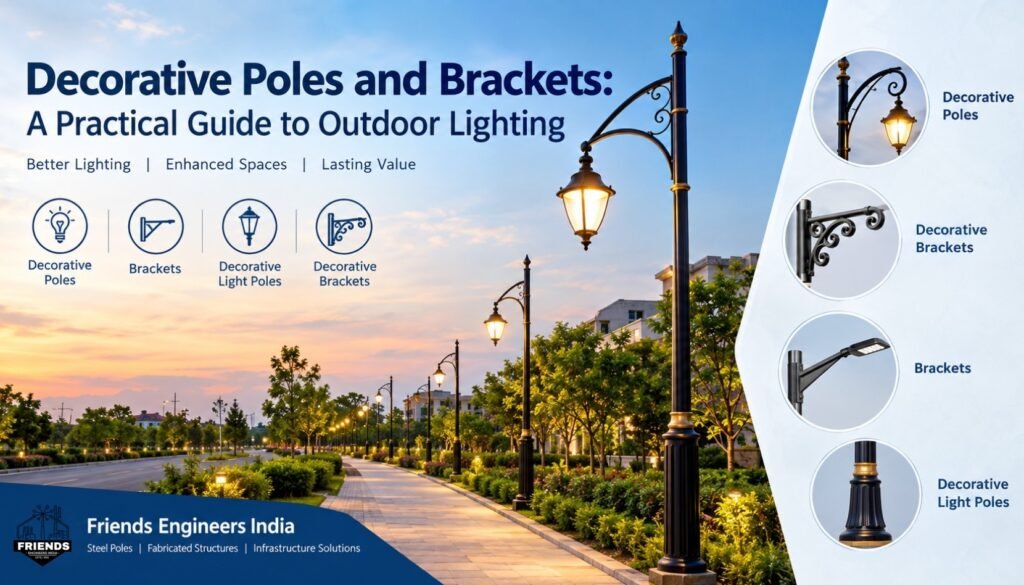
Decorative Poles and Brackets: A Practical Guide for Better Outdoor Lighting
Outdoor lighting is no longer just about making roads, pathways, and public areas visible after sunset. Today, lighting also contributes to the appearance, character, safety, and overall experience of a space. This is where decorative poles and well-designed lighting supports can make a real difference. From landscaped roads and parks to hotels, commercial developments, residential projects, institutional campuses, and public spaces, the right lighting structure can combine functionality with visual appeal. However, choosing an attractive design is only one part of the process. The pole and its supporting components must also provide the required strength, durability, and performance. In this guide, we will look at decorative lighting poles, brackets, their applications, materials, important selection factors, and what to consider when choosing a manufacturer. What Are Decorative Poles? Decorative poles are lighting poles designed to combine structural performance with an attractive appearance. Unlike conventional utility or lighting poles that are primarily focused on function, decorative designs place greater emphasis on shape, proportions, finish, and overall visual integration with the surrounding environment. Friends Engineers India manufactures decorative poles for applications including parks, gardens, pathways, streets, commercial areas, public spaces, landscaping projects, and architectural developments. Depending on the project, decorative poles can be manufactured in different heights, designs, mounting arrangements, and finishes. Common applications include: The objective is simple: provide reliable lighting support without compromising the appearance of the space. Why Are Decorative Light Poles Becoming Popular? Modern infrastructure projects increasingly consider both functionality and aesthetics. A lighting installation should provide suitable illumination, but it should also complement the architecture and landscape around it. This is one reason decorative light poles are increasingly considered for projects where appearance matters. 1. They Improve Visual Appeal A well-designed pole can become part of the overall landscape design. Instead of looking like an independent utility structure, it can complement buildings, pathways, gardens, roads, and other architectural elements. 2. They Provide Functional Lighting Support Despite their decorative appearance, these poles still have an important structural role. They need to safely support the selected lighting fixture and withstand the conditions expected at the installation site. For road and street lighting applications, the lighting fixture itself may also need to comply with applicable standards. For example, IS 10322 (Part 5/Sec 3) covers requirements for luminaires used for road and street lighting and other public outdoor lighting applications. 3. They Offer Design Flexibility Every project has its own architectural style. Decorative poles can therefore be developed in different configurations to suit the required height, design, mounting arrangement, and finish. 4. They Work Across Different Outdoor Environments Decorative lighting structures can be used in landscaped areas, commercial developments, pedestrian pathways, public spaces, institutional premises, and other outdoor environments. Understanding Brackets in Lighting Pole Applications A lighting pole is only one part of a complete outdoor lighting structure. The bracket or supporting arm is equally important because it helps position and support the lighting fixture. Brackets are fabricated components used to mount lighting fixtures to poles or other structures. Their design needs to be compatible with the pole, luminaire, mounting arrangement, and project requirements. Depending on the application, brackets may be designed for: The appropriate bracket design depends on factors such as fixture weight, projection, mounting height, wind conditions, pole dimensions, and the intended application. What Makes Good Decorative Brackets? A decorative bracket should not be selected based on appearance alone. Although its design contributes to the visual character of the lighting installation, the bracket is also a structural component. It therefore needs to be properly designed and fabricated for its intended application. Important considerations include: 01. Structural suitability The bracket should be capable of supporting the intended lighting fixture and handling the expected loads. 02. Accurate fabrication Cutting, bending, welding, and finishing should be carried out accurately to achieve consistency and proper installation. 03. Compatibility The bracket should match the pole and lighting fixture so that the complete assembly works as intended. 04. Surface protection Outdoor components are exposed to rain, humidity, dust, sunlight, and changing temperatures. Suitable surface protection can help improve resistance to corrosion and environmental exposure. 05. Consistent design For large projects, using matching brackets across multiple poles can create a more uniform and professional appearance. Materials Used for Decorative Lighting Structures Steel is commonly used for lighting poles and fabricated support components because of its strength, versatility, and suitability for fabrication. Depending on the project, mild steel or galvanised steel may be considered. The final selection depends on factors such as: For outdoor structures, corrosion protection deserves particular attention. Proper surface treatment can help protect steel components against moisture and environmental exposure. It is also important to consider the lighting system as a whole rather than selecting the pole independently from the luminaire. The Bureau of Indian Standards maintains standards covering luminaires and outdoor lighting applications, including road and street lighting. How to Choose the Right Decorative Pole? Choosing a decorative lighting pole involves more than selecting a design from a catalogue. The pole should be suitable for the location, lighting requirement, structural conditions, and overall project design. 1. Consider the Installation Location A pole installed beside a major road may have different requirements from one installed in a landscaped garden or hotel driveway. Consider factors such as: 2. Select the Appropriate Height Pole height affects lighting distribution, appearance, and structural requirements. A pole that is too short may not provide the desired coverage, while an unnecessarily tall pole may increase material requirements and affect the visual balance of the area. 3. Check the Bracket Configuration The bracket should be suitable for the lighting fixture and pole. Depending on the project, single-arm, double-arm, curved, straight, or customised configurations may be required. 4. Consider Surface Protection Outdoor steel structures require suitable protection against corrosion. The appropriate treatment should be selected according to environmental exposure and project specifications. 5. Think About Customisation Large infrastructure projects often require specific dimensions, designs, or mounting arrangements. Working with a manufacturer that can fabricate products according to project drawings and specifications can